
Blog
Relax the Upper Body—They Said. It’ll Be Easy—They Lied.

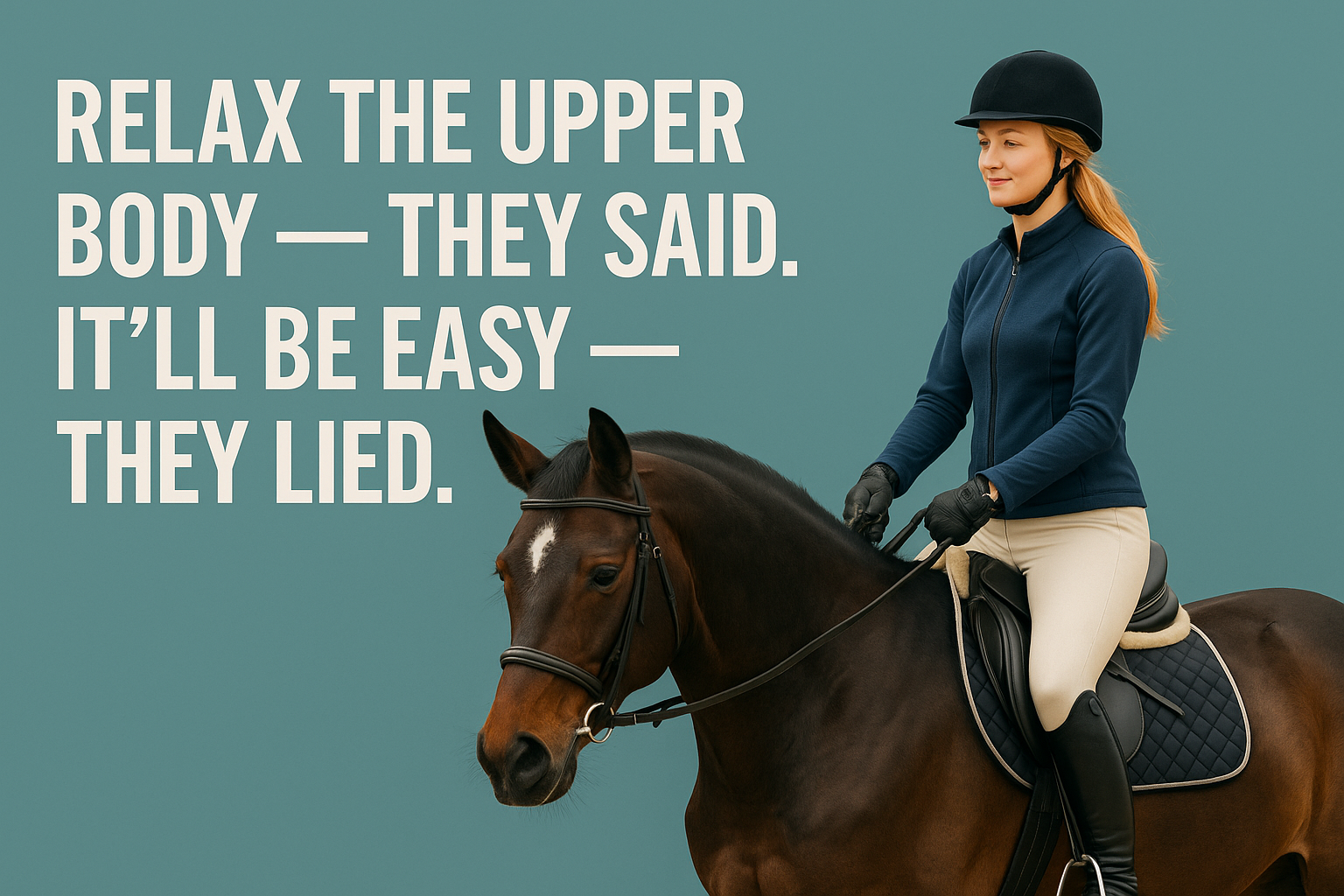
Ask any instructor for the most important riding habit, and you’ll hear it:
“Relax your upper body.”
Easy in theory.
In practice? A scientific impossibility—or at least it feels like it.
Because the moment a horse transitions to trot, every beginner rider’s spine becomes a vibrating instrument of chaos, and the upper body invents 17 new ways to panic.
But here’s the professional truth behind the comedy:
✅ Why relaxation actually matters
When a rider tenses up—shoulders clenched, arms stiff, elbows locked—three things happen:
- You bounce more.
(The horse moves up, you move up more. Basic physics. Bad for dignity.) - Your hands get rigid.
Which means the bit suddenly feels like a microphone detecting earthquakes. - The horse thinks something is wrong.
Because in horse language, tight rider = danger.
Relaxation isn’t just “looking nice.”
It’s communication, balance, and biomechanics working together.
✅ What “relaxed” actually means in a professional sense
- Soft elbows that act like shock absorbers
- Loose shoulders that allow the arms to follow the motion
- Breathing normally (instead of holding your breath like you’re defusing a bomb)
- Core engaged, muscles elastic, not floppy, not rigid
In other words:
Your body should move with the horse, not against it, not independently of it, and definitely not like a terrified tree trunk.
✅ Why the body refuses to cooperate
Because the human brain says:
“Balance!”
And the human muscles say:
“Tighten everything!”
Meanwhile, professional riding instructors worldwide spend half their careers repeating:
- “Shoulders down.”
- “Don’t grip with your hands.”
- “Breathe.”
- “No, actually breathe.”
And riders reply,
“I AM RELAXED!”
while looking like a marble statue during an earthquake.
✅ How to actually get there
- Exhale deeply when the horse changes gait
- Keep elbows close, not stiff
- Imagine holding baby birds—firm enough not to drop, soft enough not to crush
- Let the horse’s motion move through your hips, not your shoulders
- Laugh at your mistakes—it’s impossible to stay tense while laughing
Professional trainers will tell you: relaxation is a skill, not luck.
Your body learns it slowly… and then suddenly all at once.
One day you’re bouncing like a shopping cart with a broken wheel,
and the next day your instructor says,
“That’s it. Don’t change a thing.”
✅ The punchline?
The more relaxed you are,
the smoother the horse becomes.
The smoother the horse becomes,
the more relaxed you are.
It’s a feedback loop of joy.
So yes—“Relax the upper body” sounds easy.
But when you finally master it,
you’re not just sitting on a horse anymore—
you’re riding.